
Fears of a protracted confrontation and delays to the flow of oil through the Strait of Hormuz increased on Thursday as Iran increased its attacks on oil and transportation infrastructure around the Middle East.
Following allegations that several tankers had been attacked in Iraqi seas and that drone assaults had targeted Oman's energy infrastructure, Brent crude jumped. The increase contributed to the growing security threats along one of the most vital oil transportation routes in the world.
Attacks on ships passing through or close to the strategically significant Strait of Hormuz have increased, according to authorities, who reported that three more foreign ships were hit in the Persian Gulf overnight.
The United Kingdom Maritime Trade Operations (UKMTO) center reported on Thursday that a container ship was hit by an unidentified projectile around 35 nautical miles north of Jebel Ali, a significant port city close to Dubai in the United Arab Emirates. There was a little fire on board as a result of the event, but everyone on board was said to be safe.
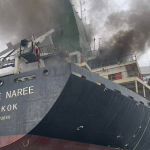
Earlier, two foreign oil tankers were hit close to the port of Umm Qasr, which is close to the city of Basra, and were left burning in Iraqi seas.
According to several media sources citing Iraqi port officials, the attack resulted in at least one fatality and the rescue of 38 crew members from the ships.
Since the United States and Israel began airstrikes on Iran on February 28, shipping through the Strait of Hormuz has essentially stopped. Iran has responded by attacking ships attempting to cross the strait; multiple incidents have been documented in recent days.
To help control prices that have skyrocketed since the start of the U.S.-Israeli assault on Iran, the International Energy Agency has decided to release a record 400 million barrels of oil. The majority of that release—172 million barrels—is coming from the United States' Strategic Petroleum Reserve.
According to Tina Teng, a market strategist at Moomoo ANZ, "the IEA's release of oil reserves may only be a temporary solution as disruptions to oil shipments through the Strait of Hormuz and a major production halt in some Middle Eastern countries could cause a long-term supply crunch."
Oman's energy infrastructure was also under strain. Large fires were started by drone strikes at the Mina petroleum plant close to the Port of Salalah, and as a precaution, authorities evacuated ships from the neighboring Mina Al Fahal oil export terminal. One of the few regional export hubs outside the Strait of Hormuz, Mina Al Fahal processes about one million barrels of Omani crude per day.
The renewed supply shock caused financial markets to respond. As worries about inflation and global borrowing costs increased due to the spike in oil prices, stocks fell.
U.S. Fed funds futures continued to decline in the rates markets, with traders currently expecting only about 26 basis points of interest rate reduction for this year.
Iran has a tight grip over the Strait of Hormuz, the waterway that connects the Persian Gulf to the Indian Ocean and transports a fifth of the world's oil, in addition to assaulting the region's energy infrastructure.
The price of Brent crude oil, the worldwide standard, increased by another 9% to above $100 per barrel, up almost 38% from when the war began, as commerce in the strait essentially stopped.
Iran strikes a ship in the Persian Gulf and shoots at Gulf Arab nations. A resolution calling for an end to Iran's "egregious attacks" on its Gulf neighbors was approved by the U.N. Security Council on Wednesday, but Tehran showed no signs of altering its course.
According to the British military's United Kingdom Maritime Trade Operations Center, a container ship in the Persian Gulf was struck by a missile off the coast of Dubai early on Thursday, starting a small fire. It stated that the ship's crew was secure.
The U.N. Security Council approved a resolution on Wednesday urging a halt to Iran's "egregious attacks" on its Gulf neighbors, but Tehran showed no signs of changing its ways.
The United Kingdom Maritime Trade Operations Center of the British military reports that early on Thursday, a missile impacted a container ship in the Persian Gulf off the coast of Dubai, igniting a small fire. The crew of the ship was said to be safe.